
 Microsoft Fabric
 22.06.2026
12, Rue du Chateau D'eau, Leudelange, L-3364, Luxembourg
 Microsoft Fabric
22.06.2026
Microsoft Fabric
22.06.2026
What if you could migrate decades of complex business logic to the cloud without rebuilding a single measure from scratch? You've spent years refining your SQL Server Analysis Services (SSAS) cubes, and the thought of a manual rebuild is understandably daunting. It's common to feel a sense of hesitation when facing the retirement of Power BI Premium P-SKUs in 2026, especially when you're balancing performance concerns with the complexity of hybrid data environments.
We understand that your goal isn't just to move data, but to modernize your entire analytical foundation. This guide empowers you to master an SSAS migration to Microsoft Fabric while preserving your critical business logic and unlocking the transformative speed of Direct Lake mode. By shifting from static on-premise models to OneLake-integrated assets, you'll eliminate the need for traditional data imports and significantly reduce your infrastructure maintenance. We'll explore the strategic steps to transition your semantic models smoothly, ensuring your reports run faster and your team stays focused on driving value rather than managing servers.
The deadline for modernizing your data infrastructure is no longer a distant date on a roadmap. In 2026, the data landscape is shifting rapidly. With the end of support for SQL Server 2016 arriving in July and the retirement of Power BI Premium P-SKUs, businesses still relying on legacy SQL Server Analysis Services (SSAS) face a critical choice. You can continue to patch aging systems, or you can embrace a unified SaaS platform that scales with your ambition.
An SSAS migration to Microsoft Fabric represents more than a simple cloud move. It's a fundamental shift from fragmented data silos to a "OneLake" single source of truth. By moving your business logic into Fabric, you're shedding the technical debt associated with server-based models. This transition unlocks advanced capabilities like Copilot. Your team can use AI-driven insights to query data and build reports in seconds rather than hours, turning complex datasets into actionable narratives without the manual heavy lifting.
Legacy environments are often defined by their bottlenecks. On-premise hardware comes with rigid memory constraints. When your data volume spikes, performance inevitably dips unless you invest in costly hardware upgrades. The financial burden is also significant. Between physical server maintenance and perpetual licensing, the total cost of ownership remains high while the flexibility remains low. Connecting legacy cubes to modern cloud-native tools often requires fragile "glue code" that's difficult to maintain and prone to failure. These silos prevent your organization from achieving the real-time responsiveness that modern markets demand.
Transitioning to Fabric changes the dynamic from maintenance to innovation. Because Fabric is a SaaS offering, it integrates natively with the Microsoft 365 and Power BI stack your team already uses. This creates a cohesive experience where data flows naturally between departments. Governance becomes a built-in feature rather than an afterthought, thanks to deep Microsoft Purview integration. By utilizing the open Delta Parquet format, Fabric eliminates the "import dax." You no longer need to duplicate data across multiple systems. This reduces storage costs, which are approximately $0.023 per GB in OneLake, and ensures every user is working from the same verified data set.
At Momentum One, we specialize in helping organizations navigate this shift through our Fabric Migration & Modernization services. We ensure your logic remains intact while your performance reaches new heights.
The shift from legacy cubes to modern semantic models isn't just a change in hosting. It's a total evolution of how data is stored and accessed. Traditional SSAS relies on proprietary storage formats that often feel like a "black box." In contrast, an SSAS migration to Microsoft Fabric moves your logic into a transparent, open-standard environment powered by Delta Lake. This transition means your data is no longer trapped in a specific tool. It's stored in Parquet files that any Fabric engine can read, which facilitates better interoperability across your entire data team.
XMLA endpoints play a vital role in this modernization. They serve as the communication bridge, allowing you to use familiar tools to deploy and manage your models. When using the Fabric Migration Assistant, these endpoints enable a streamlined transfer of your existing Tabular models. This ensures that your enterprise workloads benefit from Fabric's high-concurrency capabilities. Unlike on-premise servers with fixed memory, Fabric capacities scale to meet demand. This provides a consistent experience for hundreds of concurrent users without the risk of server crashes or performance degradation during peak usage hours.
The complexity of your journey often depends on your current SSAS architecture. If you're running Tabular models, the SSAS migration to Microsoft Fabric is largely a "lift-and-shift" operation. You can move your BIM files directly to a Fabric workspace with minimal refactoring. However, multidimensional models require more strategic thought. Converting MDX logic to DAX is a significant undertaking, especially when dealing with complex parent-child hierarchies. We recommend auditing these hierarchies early to determine if they should be rebuilt or simplified for a cloud-native environment to ensure long-term maintainability.
OneLake serves as the foundation for this new architecture, acting as a "OneDrive for data." One of its most powerful features is "Shortcuts." This allows you to link data from external sources without actually copying it. This eliminates the data duplication issues common in legacy environments. Direct Lake mode acts as the bridge between Import and DirectQuery, providing the speed of memory with the freshness of a direct connection. By removing the need for scheduled refreshes, your team gains access to real-time insights without the typical "import tax" delay.
Transitioning your architecture requires a steady hand and a clear vision. If you're looking to optimize your logic during this shift, our team provides expert data architecture modernization to ensure your new models are built for long-term growth and performance.
For decades, SSAS developers have lived with the "Import tax." You either chose the high performance of Import mode, which required lengthy scheduled refreshes, or the real-time freshness of DirectQuery, which often suffered from sluggish report latency. An SSAS migration to Microsoft Fabric effectively resolves this trade-off through Direct Lake mode. This technology allows the Power BI engine to read Delta Parquet files directly from OneLake without any data movement or duplication. It provides the speed of memory-resident data with the immediate availability of a direct connection.
The technical mechanism is remarkably elegant. When a report is accessed, the Analysis Services engine pages only the necessary columns from the Delta files into memory. This "on-demand" loading means that even multi-terabyte models can be queried with sub-second response times. Large-scale enterprise models that currently take hours to process in an on-premise environment are the prime candidates for this transition. By eliminating the processing window, your data is ready for analysis the moment it's written to the Lakehouse, ensuring your business users always work with the latest figures.
While Direct Lake is incredibly powerful, it isn't a magic wand for poorly constructed models. Efficient DAX is more critical now than ever. If a measure is too complex or uses unsupported functions, the engine may "fall back" to DirectQuery mode, which significantly impacts performance. Many legacy SSAS measures were written with different architectural constraints in mind and may require refactoring to stay within the Direct Lake "hot path." If you're encountering performance bottlenecks during your transition, our DAX optimization experts can help you tune your logic for maximum cloud efficiency.
Transitioning to Fabric also changes how you manage compute resources. Instead of fixed server hardware, you'll utilize Fabric F-SKUs. This provides much-needed flexibility. For example, a small organization might start with an F2 capacity for approximately $262 per month, while larger enterprises can scale up to F2048 for massive workloads. It's important to note that opting for a 1-year reserved capacity can result in a 41% discount compared to pay-as-you-go pricing. Monitoring your compute usage is essential to avoid performance throttling during peak month-end reporting cycles. We recommend using the Fabric Capacity Metrics app to gain a transparent view of your resource consumption and scale your capacity dynamically as your business demand fluctuates.
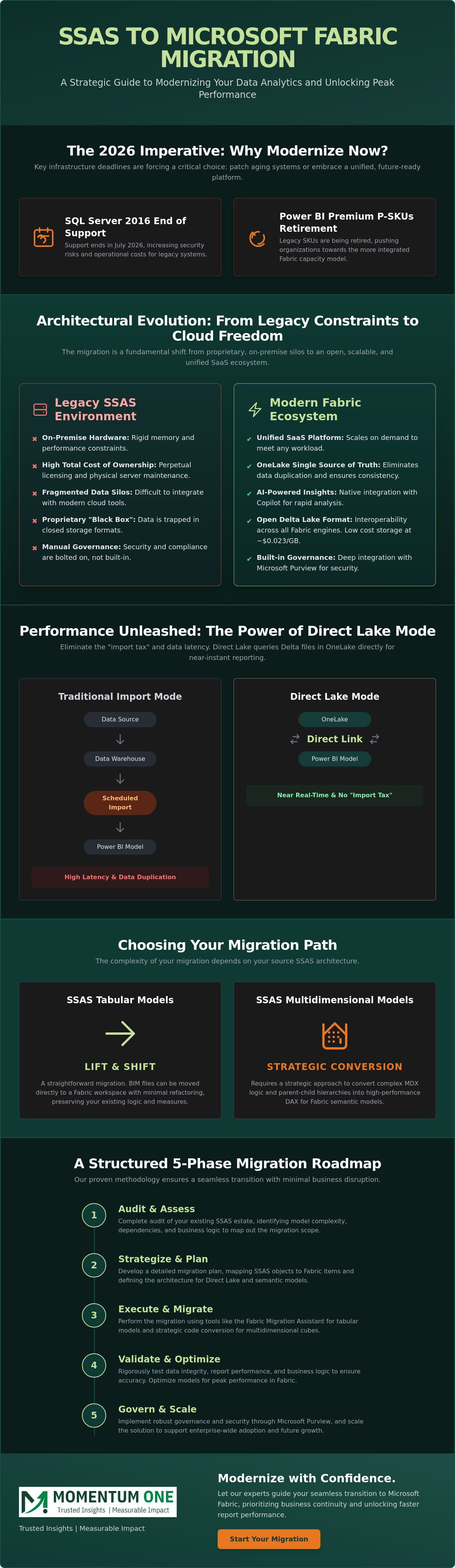
Success in an SSAS migration to Microsoft Fabric isn't achieved by chance. It requires a methodical framework that accounts for every relationship, measure, and security role. Moving from a legacy environment to a unified SaaS platform is a significant shift that demands a steady hand. By following a structured roadmap, you can ensure that your business logic remains intact while you transition to a more agile, cloud-native architecture that's built for the future.
The first step is a deep dive into your existing estate. You shouldn't migrate what you don't use. We find that many organizations carry "dead wood" in the form of unused measures and obsolete reports that only add complexity to the migration. This phase involves auditing your current models to reduce the migration scope. We also assess your data security requirements. Mapping Row-Level Security (RLS) from SSAS to Fabric is a vital task to ensure that sensitive data remains protected. Finally, we evaluate the health of your existing data pipelines to determine which ones are ready for modernization and which require refactoring.
Once the audit is complete, we move into Phase 2: Architectural Alignment and Phase 3: Logic Translation. This is where we map your SSAS objects to their Fabric equivalents, such as Lakehouses or Semantic Models. We then tackle the translation of MDX into DAX. This isn't just a copy-paste job. It's an opportunity to optimize your measures for the Direct Lake performance we discussed earlier, ensuring your logic is as efficient as possible in its new home.
Validation is the cornerstone of a successful transition. For large datasets, manual checking isn't enough. We utilize automated validation techniques to compare source and target data at scale. This helps identify rounding differences or complex calculation logic that might behave differently in the cloud. You can use the XMLA endpoint to connect both the source SSAS and the target Fabric model to a tool like DAX Studio for side-by-side calculation comparison. This rigorous testing ensures that your business users can trust the numbers from day one.
The final phase is the cutover to production and the establishment of long-term oversight. We define clear workspace roles and access permissions to maintain a secure environment. Integrating Microsoft Purview allows for end-to-end data lineage, giving you full visibility into how data moves through your new Fabric ecosystem. Proper oversight is what turns a one-time migration into a sustainable data strategy. If you want to ensure your new environment remains organized and compliant, our team provides comprehensive Power BI Consulting & Governance to guide your long-term success.
Ready to start your journey? Let our experts handle the heavy lifting of your Fabric Migration & Modernization so you can focus on the insights that drive your business forward.
Completing an SSAS migration to Microsoft Fabric is a significant milestone for any data driven organization, but the technical shift is only one part of the story. We act as your strategic partner throughout this journey, ensuring that your transition doesn't disrupt daily operations or compromise data integrity. Our approach prioritizes business continuity by building tailored strategies that respect your existing workflows. We understand the value of the logic you've built over decades, and we're committed to preserving that intellectual property while moving it into a more agile, cloud native environment.
Working with a certified partner provides more than just technical implementation. It gives you direct access to deep expertise in DAX optimization and proactive architectural reviews that prevent common pitfalls before they occur. We've led enterprise grade migrations across the country, providing the steady hand needed to handle complex legacy dependencies. Our team doesn't just follow a checklist. We dive into the nuances of your specific data models to ensure they're not just moved, but truly modernized. This level of professional authority ensures your new Fabric environment is stable, secure, and ready to scale from day one.
Our commitment to your success extends far beyond the initial cutover. We address the common industry gap where support ends once the data is moved. Through our managed services, we provide continuous performance tuning to keep your environment running at peak efficiency. We monitor your Fabric capacity usage to ensure your compute costs remain predictable and your reports stay fast. This long term oversight allows your internal team to focus on high value strategic initiatives while we handle the technical maintenance and ongoing optimization of your unified data stack.
Adoption is just as important as the technology itself. We empower your staff through customized technical training solutions. These sessions are designed to bridge the gap between legacy SSAS knowledge and modern Fabric capabilities. We help your developers and analysts become confident in managing the new ecosystem, ensuring they can leverage features like Direct Lake mode and Copilot to their full potential.
Every successful project starts with a high level architectural review. This assessment is the most effective way to identify your Fabric readiness and highlight potential risks before they become costly delays. It provides a clear, transparent roadmap for your modernization efforts. If you're ready to leave behind the constraints of legacy hardware and embrace the future of SaaS analytics, we're here to guide you. Explore our Fabric Migration & Modernization services to see how we can help you transition with total confidence.
The transition from legacy cubes to a unified SaaS platform is more than a technical upgrade. It's a strategic move that eliminates infrastructure debt while providing your team with the unprecedented speed of Direct Lake mode. By following a structured roadmap, you can protect your existing business logic and ensure a seamless shift to a modern, AI-ready environment. An SSAS migration to Microsoft Fabric is the definitive step toward a data estate that's built for scale and innovation.
As a Certified Microsoft Solutions Partner, Momentum One combines national reach with boutique-level dedication to your success. Our deep expertise in complex DAX and data modeling ensures that your new semantic models are optimized for peak performance from day one. We act as your steady hand through every phase of the journey, simplifying complexity and prioritizing your business continuity. We don't just move your data; we modernize your entire analytical approach.
Your journey toward a modernized data stack doesn't have to be daunting. Partner with Momentum One for your Microsoft Fabric migration and turn your legacy data into a dynamic asset. We're ready to help you unlock the full potential of your analytical foundation and drive lasting growth for your organization.