
 Microsoft Fabric
 21.06.2026
12, Rue du Chateau D'eau, Leudelange, L-3364, Luxembourg
 Microsoft Fabric
21.06.2026
Microsoft Fabric
21.06.2026
What if the reason your team spends hours every Monday arguing over which spreadsheet is 'correct' isn't a lack of effort, but a fundamental flaw in your data architecture? Improving report accuracy is rarely a 'checking' problem that can be solved with more manual oversight. You've likely felt the frustration of presenting a key performance indicator only to have a stakeholder point out a conflicting figure from another department. This scenario is a common reality for leaders in Luxembourg. Decision-making paralysis often stems from a loss of trust in the underlying numbers.
We're here to show you that a high-trust reporting environment is a structural result of robust data governance and modern architecture. In this article, we'll explore how to eliminate conflicting metrics by establishing a single source of truth through automated validation and frameworks like ALCOA+. Discover how to transition from time-consuming manual reconciliation to a proactive strategy that delivers reports your stakeholders can finally rely on.
Accuracy in a modern data stack isn't a static target. It's the precise alignment between your raw inputs and the complex business logic that defines your success. Many organizations confuse data quality with report accuracy, but they aren't the same. Data quality ensures that the raw data entering your system is clean, formatted, and complete. Improving report accuracy, on the other hand, focuses on the integrity of the transformed output. It's about ensuring that when a manager in Luxembourg looks at a dashboard, the "Net Revenue" figure accounts for every specific local tax and rebate exactly as intended.
We often see a "Trust Gap" emerge when these elements fall out of sync. This gap is the distance between the data presented and the stakeholder's willingness to act on it. To close it, we look at the three pillars of accuracy: Source, Transformation, and Presentation. Maintaining Data integrity across these pillars ensures that the story your data tells remains consistent from the moment it's captured to the moment it's visualized. Our Power BI Consulting & Governance services are designed specifically to bridge this gap by architecting systems where logic is transparent and reliable.
Acting on miscalculated data carries heavy financial risks. If a supply chain report "hallucinates" inventory levels due to a logic error, a company might over-order stock, tying up thousands of Euros in capital. Beyond direct costs, manual reconciliation cycles drain your most expensive technical resources. When senior analysts spend 20 hours a week "fixing" numbers in Excel, they aren't performing the high-value analysis you hired them for. This inefficiency eventually erodes executive trust in self-service BI platforms, leading leaders back to gut-feeling decisions rather than data-driven ones.
How do you know if your system is struggling? The signs are usually visible long before a major error occurs. Common symptoms include:
Improving report accuracy requires moving past these symptoms to address the structural flaws in the data model itself.
For many national enterprises in Luxembourg, the biggest hurdle to reliable analytics isn't a lack of data. It's the fragmentation of that data across disconnected systems. When every department maintains its own version of a "Sales Report," the business loses its ability to make unified decisions. Establishing a Single Version Of Truth is the only way to ensure everyone speaks the same language. Microsoft Fabric addresses this by centralizing these fragmented silos into a unified Lakehouse environment.
OneLake serves as the foundation of this architecture. Think of it as a "OneDrive for data" that eliminates the need to move or copy information between different tools. By pulling all reports from this single, verified environment, organizations can significantly reduce the risk of conflicting numbers. Improving report accuracy becomes a much simpler task when you no longer have to worry about which version of the data is the most recent. If your organization is currently managing a patchwork of legacy systems, exploring a Fabric migration and modernization can be the catalyst for this structural shift.
Siloed Excel files are often the primary enemy of reporting precision. When transformation logic lives inside individual spreadsheets or local Power BI files, it's invisible and prone to human error. We advocate for moving this logic out of the report layer and into the Lakehouse. By using automated data pipelines, you reduce the need for manual intervention during data preparation. This ensures that calculations for complex metrics, such as EBITDA or customer churn, are defined once at the warehouse level and inherited by every dashboard. This "write once, use everywhere" approach is a cornerstone of any strategy for improving report accuracy.
Technology alone won't solve the problem without clear ownership. Effective governance involves defining who is responsible for specific data domains, such as Sales, Finance, or Operations. We help teams implement "certified datasets" within their environment. These labels act as a digital seal of approval, signaling to users that a report is verified and ready for executive use. When a stakeholder sees a certified icon, they know the numbers have passed rigorous validation checks. Governance acts as the essential guardrail that prevents accurate data from drifting into unverified chaos.
Our team often finds that a structured approach to ownership is what transforms a confusing data environment into a high-trust asset. If you're unsure where your current governance gaps lie, a professional audit can help identify the hidden logic flaws in your existing models.
Establishing a single source of truth in Microsoft Fabric is a vital first step, but the technical structure of your data model determines whether your reports remain reliable over time. Many organizations struggle with "ghost numbers" that change depending on which filter a user selects. This instability often stems from poor modeling choices rather than incorrect raw data. Improving report accuracy at this level requires a shift from simply connecting tables to architecting a resilient Star Schema. Our Power BI consulting & governance team focuses on this structural integrity to ensure every calculation remains consistent across the entire enterprise.
Precision also depends on how you manage your business logic. We recommend separating "Base Measures" from report-specific visuals. When you define a metric like "Total Margin" once as a core measure, you eliminate the risk of different users creating slightly different versions of the same calculation in their own reports. This centralized approach to logic ensures that when a board member in Luxembourg asks for a specific figure, the answer is identical regardless of which dashboard they're viewing.
Flat tables are often the primary cause of "double counting" in Power BI. When you try to cram every piece of information into a single large table, aggregations quickly become inaccurate because data is repeated across multiple rows. The Star Schema is the gold standard for a reason. By separating your data into Fact tables (the events, like sales) and Dimension tables (the context, like products or dates), you create a clean, logical flow. This architecture simplifies your calculations and significantly reduces the risk of logic errors. Proper modeling ensures that filters behave predictably, which is essential for maintaining stakeholder trust in your analytics.
Complex DAX (Data Analysis Expressions) can act as a black box that hides subtle calculation errors. We often see models where the improper use of functions like CALCULATE or a misunderstanding of filter context leads to accurate-looking but false numbers. These errors are dangerous because they don't cause the report to fail; they just produce the wrong result. Performance tuning and accuracy go hand-in-hand here. A model that runs slowly is often a sign of inefficient DAX that's trying to work around a poor data model. Optimized DAX is inherently easier to audit and validate because the logic is transparent and direct.
By focusing on these structural elements, you move beyond troubleshooting symptoms and begin building a system that's accurate by design. This foundation allows you to implement more advanced automated validation checks, which we'll explore in the next section.
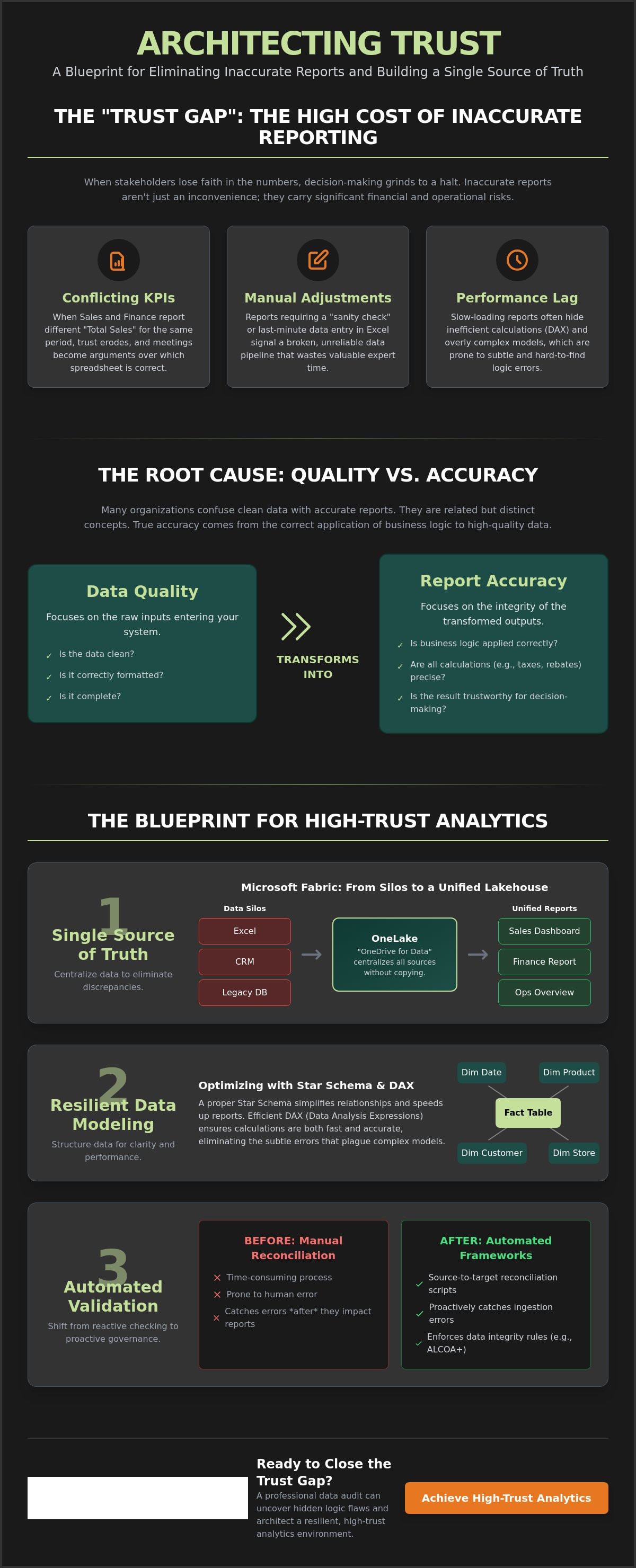
Manual reconciliation is more than a nuisance; it's a structural vulnerability. Improving report accuracy requires moving away from human-led "spot checks" toward automated validation frameworks that operate in real time. By establishing source-to-target reconciliation scripts, you create a digital handshake between your source systems and your Lakehouse. These scripts automatically compare row counts and sum totals to ensure that no data was lost or mangled during the ingestion process. This technical safety net catches errors at the door before they can pollute your downstream analytics.
Proactive alerting is the next layer of defense. If a key metric like "Monthly Recurring Revenue" shows a variance of +/- 20% compared to the previous period, the system should trigger an immediate notification. This allows your data team to investigate anomalies before a report ever reaches an executive's screen. With the June 2026 update to Microsoft Fabric, enterprises can now leverage "Fabric Git Integration" for GitHub Enterprise Cloud. This CI/CD capability ensures that any changes to reporting logic are version-controlled and tested, effectively preventing "breaking changes" from reaching your production environment.
Consistency is the bedrock of precision. Standardizing data collection involves defining strict naming conventions and data types across your entire stack. We often help clients develop a comprehensive data dictionary. This document ensures that every department defines "Net Revenue" or "Operational Margin" identically. By reducing the reliance on unstructured data for core reporting, you eliminate the ambiguity that often leads to conflicting numbers. This alignment is particularly critical for Luxembourg firms navigating complex local and EU reporting requirements.
A reliable system requires constant vigilance. Implementing automated refresh schedules with failure notifications ensures that your stakeholders are never looking at stale information. We also utilize Power BI activity logs to monitor how data is being consumed and to identify potential bottlenecks or unusual access patterns. Regular architectural reviews are necessary to maintain accuracy as your business grows and your data requirements evolve. Improving report accuracy isn't a one-time project; it's a commitment to ongoing structural health.
If you're ready to move beyond manual checks and build a resilient data culture, our Power BI Consulting & Governance team can help you design a validation framework that secures your decision-making process.
Solving the problem of inconsistent data requires a shift in perspective. You must move beyond troubleshooting isolated symptoms and begin architecting a reliable, integrated system. Improving report accuracy is not a one-off task; it is a structural outcome of professional data engineering and clear ownership. As a Microsoft Solutions Partner based in Luxembourg, Momentum One provides the technical expertise and local market understanding necessary to scale these solutions for national enterprises. We act as a steady hand, guiding your team through the complexities of modern data stacks to ensure your analytics remain a competitive advantage.
Our approach centers on identifying the root causes of friction. A professional audit often uncovers hidden logic flaws in existing models that manual checks simply cannot find. By addressing these foundational issues, we help you transition to a high-trust environment where stakeholders no longer question the numbers. Beyond the initial setup, our managed services ensure your reporting environment maintains peak performance as your data volume grows and regulatory requirements evolve.
We follow a methodical process to transform your data landscape. This structured journey ensures that every technical change aligns with your broader business goals:
We believe in a supportive partnership that empowers your internal team. Our role is to simplify complexity, not hide behind it. This collaborative mindset extends to our training solutions, which are designed to improve internal data literacy and ensure your staff can manage the new architecture with confidence. We don't just deliver a technical product; we build a sustainable culture of accuracy. When your team understands the "why" behind the data structure, improving report accuracy becomes a shared mission rather than a technical burden.
Building a high-trust reporting environment starts with a clear understanding of your current state. If you're ready to eliminate conflicting numbers and restore stakeholder confidence, contact Momentum One for a Power BI Architectural Review. Together, we can architect a system that delivers the precision your business deserves.
Reliable reporting isn't a byproduct of more manual oversight; it's a structural result of robust architecture. By centralizing logic within Microsoft Fabric and adopting a rigorous Star Schema, you eliminate the fragmentation that causes conflicting KPIs. Implementing automated validation frameworks ensures your data remains precise from ingestion to visualization, allowing your team to focus on strategic insights rather than troubleshooting spreadsheets. This transition from reactive checking to proactive governance is essential for any enterprise aiming to lead with data.
Improving report accuracy requires a steady hand and deep technical expertise. As a Certified Microsoft Solutions Partner with over 8 years of experience in high-value implementations, Momentum One specializes in Fabric migrations and DAX optimization for the Luxembourg market. We help you move past the "trust gap" to establish a resilient, high-performance data culture. Partner with Momentum One to build a scalable, accurate data strategy that secures your decision-making process. Your journey toward high-trust analytics starts with a single, solid foundation. We're ready to help you build it.